Finding the Truth about Reality
“If your ego starts out, 'I am important, I am big, I am special,' you're in for some disappointments when you look around at what we've discovered about the universe. No, you're not big. No, you're not. You're small in time and in space. And you have this frail vessel called the human body that's limited on Earth.”
-- Neil deGrasse Tyson
By the grace of God, I was born into an expansive universe that contained two nurturing parents who were devout Christian believers in the portion of this world called Earth that is known as the religiously free and peaceful nation of the United States. And although you may argue this philosophical point of view, I feel that I was truly blessed to see God from a much different perspective than a person who had the misfortune to have been born into one of the oppressive cultures like North Korea where the freedom of an individual’s soul is severely limited. I am truly grateful for the freedoms endowed upon me by birth in this great country, and instilling in me the confidence I have in knowing that I can speak to you freely without the fear of tyranny nor the injustice of persecution. And, I apologize to anyone who sees any unintended offence in my beliefs as I attempt to explain the philosophy behind them.
My parent’s were steadfastly Christian. My father, God bless his soul, was a military man who had a profound sense of duty and a deep seated spiritual belief, that was influenced by his mainly biblical up bringing and fellowship in the “Church of Crist.” My mother, staunchly followed the ritualistic catechism of the Catholic Church and dogma of the Vatican’s Holy See in Rome. To marry my father, my mother was required to uphold the obligation to preserve his or her own faith and “ensure the baptism and education of the children in the Catholic Church,” as set forth in the 1635 catechism.
Although difficult for my father to accept, he agreed to this requirement, but frustratingly attempted to convert everyone of us to his faith through the reading of biblical scripture until we had departed into adulthood. Although my mother remained steadfast in her belief, my father’s regular unattractive diatribe of scripture to shake any stronghold that our regular exposure to dogma may have had, it only managed to convert one daughter to eventually switch to his professed fellowship, but this may have had more to do with my sister’s experience in the military and her relationship with her husband.
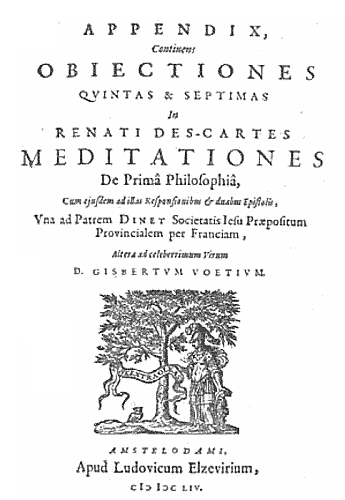
So why have I gone into such detail about the beliefs of my parents? From my first conscious moments, I was being indoctrinated into a Christian way of thinking, and it shaped the truth of what I felt that my reality was and what my imagination told me it was. Only after I could understand my the words of my English speaking parents could I begin to formulate questions about my existence, and attempt to understand the universe as the stimulus of my senses were telling me existed. And, it was early in my childhood that questioned the confidence I had in what I was perceiving to be truth was actually the reality of things. The first person to question our metaphysical thinking as to the realization of our existence in the universe was the philosopher René Descartes.
A rationalists such as Descartes often argues that certain truths exist and that the intellect can directly grasp these truths. They attempt to reason confidently that truth does not require physical proof nor evidence, and our senses could actually be lying to us. When we have an irrational experience, we often find it hard to find the truth of it, and often discard this thinking as flawed.[1] Every time I was made to attended Church, I attempted to imagine God’s existence, but the more I was taught of the Bible, the more I was founding that I often questioning the rational thinking behind what my father was claiming as the truth.
How could I except that Christ walked on water, when by nature it is not physically possible? And, even through imagination, I could not accept this as being true. It was only recently through my philosophical research that a person’s metaphysical thinking can blind them to what their senses are perceiving to be true, and my perception of what is true can be altered through knowledge. What one person claims to be true could in fact be false in my knowledge of reality, but until that person has gained enough ration thought as their knowledge of the true proof of nature and the reality of the universe, they will never believe that their perception was flawed. But it was from my father’s faithful study of the bible that I could see the truth of scientific reasoning, and my parent’s religious beliefs helped be to understand the flaws in perception that exist through dogma.
Thus, I began at this early age to then process things from the realistic perception that is the base for Descartes's proposition of Cogito ergo sum. And, is also this time that I began to see religion in the terms with which David Hume describes in his A Treatise of Human Nature. And it was not long before I began to understand that no religion belief was more flaw than the other, and the dogma of each made them equally irrational.
I once again thank the reader for their time and consideration. May God bless you harmony in the universe.
David Hume (1711-1776)
References
1 "René Descartes." Wikipedia. Wikimedia Foundation. Web. 11 Mar. 2015. <http://en.wikipedia.org/wiki/René_Descartes>.

No comments:
Post a Comment